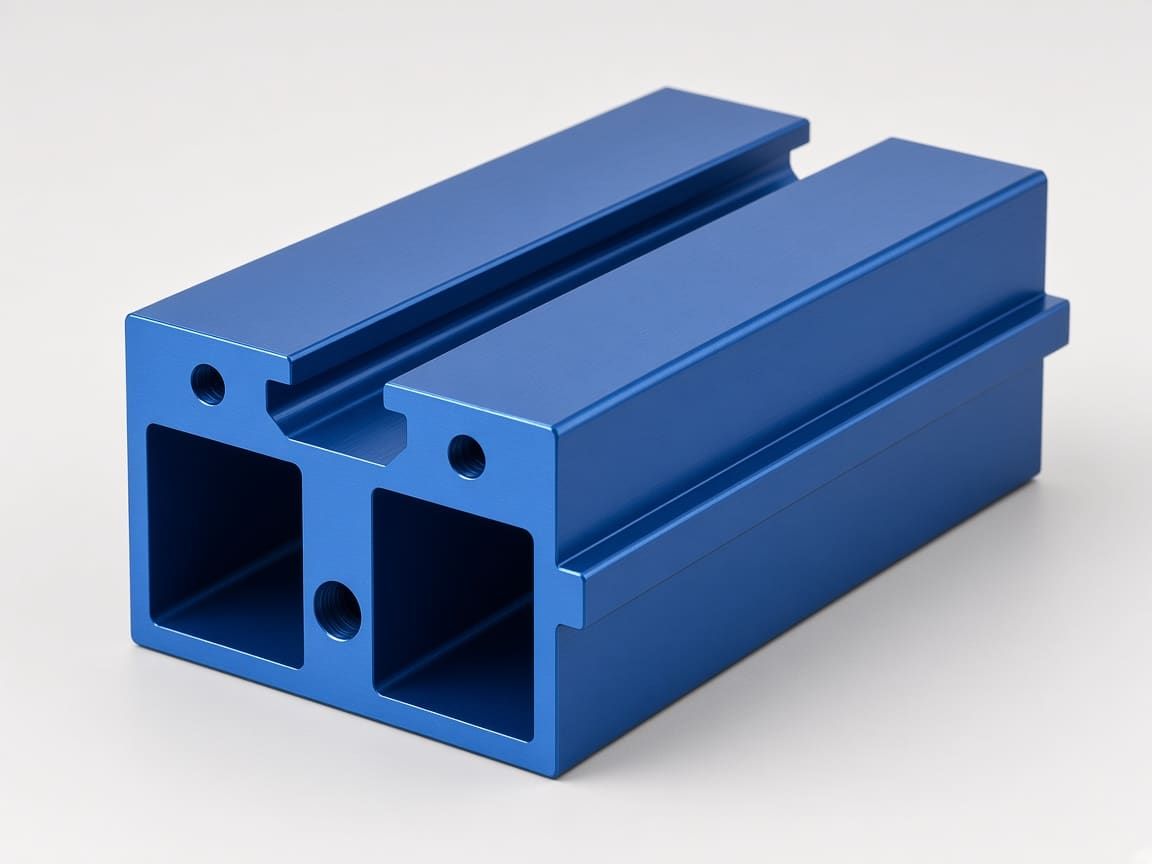
Key takeaways
- Extrusion shapes hot, solid aluminum — it is not melted. Billets are typically heated to about 450–500 °C.
- The die sets the cross-section: solid dies for open shapes, porthole dies for hollows.
- Quenching at the press and artificial aging together set the temper and strength.
- Stretching straightens the profile and relieves stress before cutting.
- Die cost is low compared with casting or molding, so extrusion suits both short and long runs.
Aluminum extrusion is a hot-forming process that turns a solid cylinder of aluminum — a billet — into a long profile with a constant cross-section, much like pressing paste through a nozzle. It is how window frames, heat sinks, T-slot framing, tubes and thousands of custom components are made.
The process at a glance
| Stage | Typical parameter | Why it matters |
|---|---|---|
| Die preheating | Around 450–500 °C | A cold die chills the metal and causes defects |
| Billet heating | About 450–500 °C for 6xxx alloys | Soft enough to flow, cool enough for good surface |
| Extrusion | Ram pressure from the press (hundreds to thousands of tonnes) | Forces metal through the die opening |
| Press quench | Air, water mist or water | Fixes the solution-treated structure for aging |
| Stretching | Roughly 0.5–3 % elongation | Straightens and relieves residual stress |
| Cutting | Saw to mill or customer lengths | Sets the delivered length |
| Aging | Typically 160–200 °C for several hours | Develops T5/T6 strength |
1. Preparing the die
The die is a thick disc of hardened hot-work tool steel (commonly H13) with an opening shaped like the profile. Solid dies make open shapes such as angles and heat sinks. Porthole or bridge dies make hollow shapes: the metal splits around supporting bridges, flows around a mandrel that forms the hollow, and re-welds inside the die’s welding chamber. Dies are preheated before use so they do not chill the billet.
2. Heating the billet
Billets are cast logs of the chosen alloy, cut to length. They are heated — typically to around 450–500 °C for 6000-series alloys — until the aluminum is soft enough to flow under pressure. Aluminum is not melted: its melting range starts well above 580 °C.
3. Extrusion
The hot billet is loaded into the press container and a hydraulic ram pushes it against the die. Under enormous pressure the metal flows through the die opening and emerges as a continuous profile. The extrusion ratio — container cross-section divided by profile cross-section — is often between about 10 and 100. Press capacity is rated in tonnes; the larger the press, the larger the circumscribing circle (the smallest circle that encloses the profile) it can handle.
Most profiles are made by direct extrusion, where the billet moves through a fixed container. Indirect extrusion, in which the die moves into a stationary billet, reduces friction but is less common for profiles.
4. Quenching at the press
As the profile exits the die at around 500 °C or more, it is cooled by air, water mist or a water wave. This press quench freezes the alloying elements in solution so that later aging can strengthen the metal. 6063 is not very quench-sensitive and can often be air-quenched; 6061 and 6082 need faster cooling to reach full T6 properties.
5. Stretching
After cooling, each length is gripped at both ends and stretched slightly — roughly 0.5–3 %. Stretching straightens the profile, removes twist and relieves residual stress, which keeps parts stable when they are later machined.
6. Cutting
Profiles are saw-cut to commercial mill lengths (commonly around 6 m) or directly to customer lengths.
7. Aging
Profiles are loaded into ovens for artificial aging, typically at around 160–200 °C for several hours. Fine Mg₂Si precipitates form inside the metal and raise its strength and hardness. A press-quenched, artificially aged profile is designated T5; a fully solution-heat-treated and aged profile is T6. See our temper guide for the details.
8. Finishing and fabrication
Most profiles then move on to secondary operations — CNC machining, cutting, punching and bending — and to surface finishing such as anodizing or powder coating.
Why engineers choose extrusion
- Low tooling cost. An extrusion die typically costs a fraction of a die-casting or injection mold.
- Integrated features. Screw ports, slots, fins and snap-fits are built into the section at no cost per part.
- Any length. One die serves every length you need.
- Good properties. Wrought 6000-series alloys offer better ductility and thermal conductivity than common casting alloys.
- Sustainability. Aluminum can be recycled repeatedly; remelting scrap needs only around 5 % of the energy of primary production.
Ready to extrude a profile? Read the design guide or send us your drawing.
Frequently asked questions
Is aluminum melted during extrusion?
No. The billet is heated until it is soft enough to flow under pressure, typically around 450–500 °C for 6000-series alloys, well below aluminum's melting range of roughly 580–660 °C.
What is the difference between direct and indirect extrusion?
In direct extrusion, the ram pushes the billet through a fixed die and the billet slides against the container wall. In indirect extrusion, the die moves into a stationary billet, reducing friction. Direct extrusion is by far the most common for profiles.
How long can an aluminum extrusion be?
Profiles leave the press in long runs and are cut to length. Commercial mill lengths are commonly around 6 m; the maximum depends on the press runout table, aging ovens and shipping.