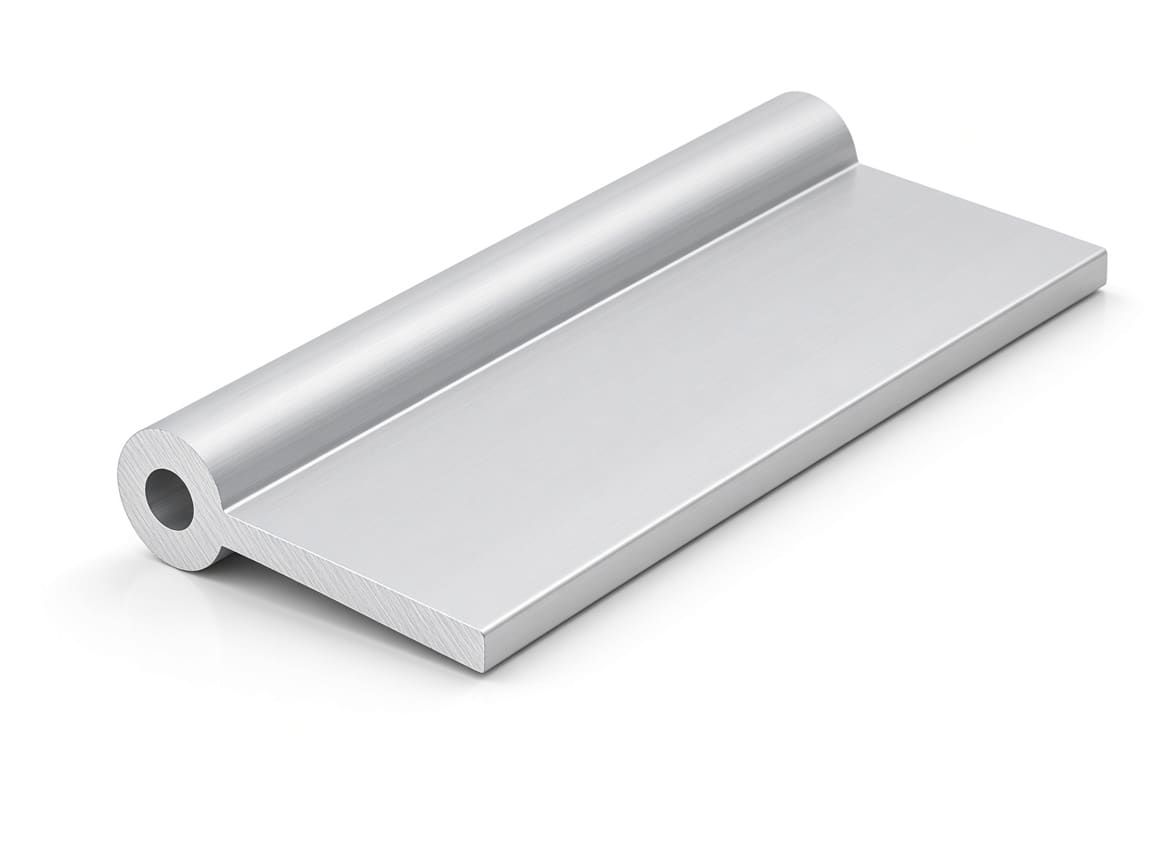
01How extruded hinges work
Two mating profiles — each with a leaf and alternating knuckles, or a leaf-and-barrel pair — are cut to length, notched where the knuckles interleave and joined by a pin through the bore. Because the knuckle and bore are formed by the die, a hinge of any length costs little more than the profile itself.
02Design considerations
- Knuckle wall — thick enough for the load and pin fit; generous radii where knuckle meets leaf.
- Pin clearance — allow for anodic layer or powder coat inside the bore.
- Bore straightness — long hinges need a straight bore so the pin runs freely.
- Fixing holes — drilled and countersunk after extrusion, before finishing.
03Where they are used
- Electrical and equipment enclosures
- Cabinets, lockers and furniture
- Machine guards and doors
- Cases, boxes and toolboxes
- Vehicle and trailer bodies
04What to send for a quote
The more of this you share, the faster and more accurate the quote. Missing something? Send what you have — we will ask.
- Hinge profile drawing or sample
- Lengths and hole pattern
- Pin diameter and material
- Finish
- Quantity
05Frequently asked questions
Can aluminum hinges be made to any length?
Yes. Because the hinge is a continuous extrusion, it is simply cut to the length you need and drilled to your hole pattern.
What pins are used with aluminum hinges?
Stainless steel pins are common for corrosion resistance and wear. Tell us the pin diameter and we will size the bore clearance.
Last updated September 17, 2026 · Reviewed by the CharMax Aluminum engineering team