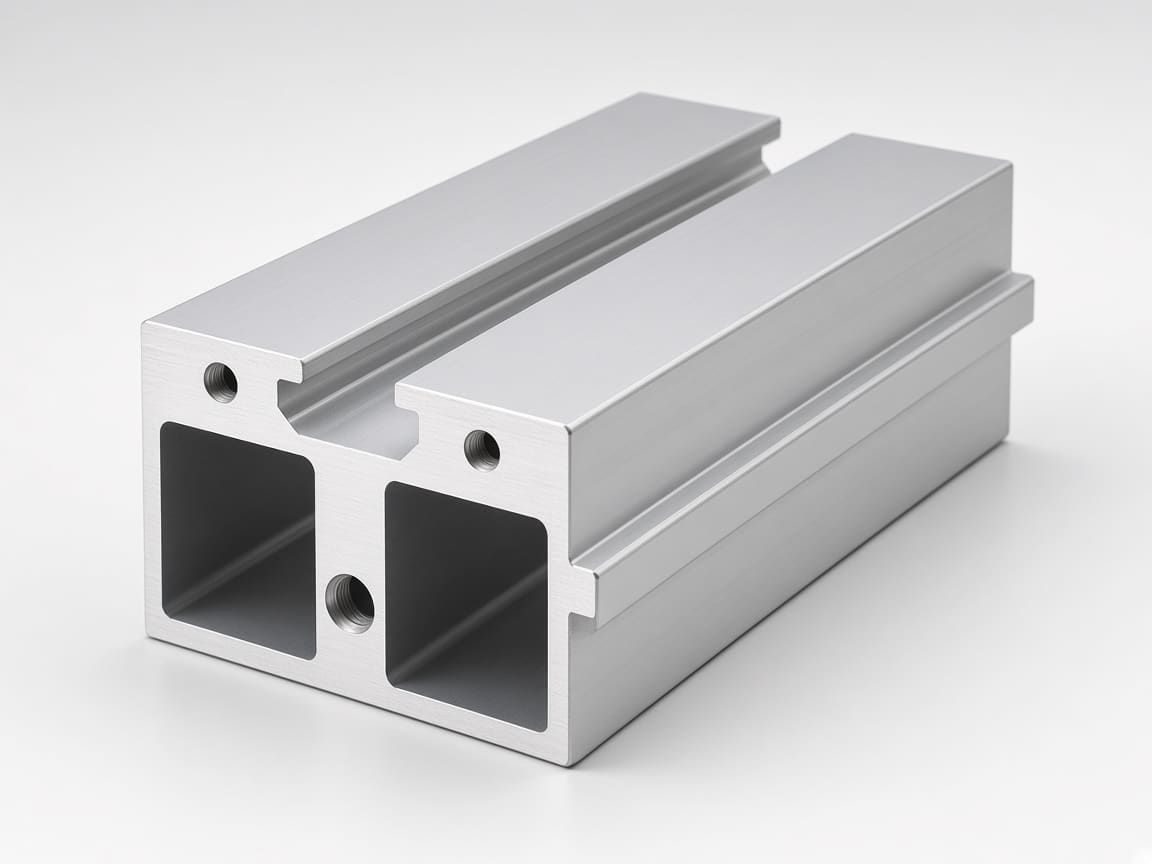
Key takeaways
- Uniform walls and generous radii are the two biggest levers on die life, speed and surface.
- Deep, narrow channels (high tongue ratios) weaken the die — redesign or expect a costlier die.
- Every feature built into the section is free on every part; every machined feature costs each time.
- A smaller circumscribing circle means a smaller press, cheaper die and lower cost.
- Specify precision only where it is functional; machine the rest.
A profile’s cost, quality and lead time are mostly decided on the drawing board. These twelve rules summarise what extrusion engineers look for in a design-for-manufacturing (DFM) review. None is absolute — function comes first — but each one you follow makes the die stronger, the press faster and the part cheaper.
1. Keep the section compact
The circumscribing circle diameter (CCD) — the smallest circle that encloses the section — decides which press can run it. Compact sections fit smaller, faster presses with cheaper dies. Wide, flat sections need big presses and are harder to hold flat.
2. Balance wall thickness
Metal flows faster through thick sections than thin ones. Large differences between adjacent walls make metal flow unevenly, causing distortion, poor dimensional control and surface streaks. Keep walls as uniform as function allows, and transition gradually where they must change.
3. Radius every corner
Sharp internal corners concentrate stress in both the die and the part. Even a 0.5 mm radius helps; 1 mm or more is better. Outside corners also benefit from a small radius, which improves anodizing and powder coating coverage.
4. Avoid knife edges
Very thin tapered edges cool faster, tear and are hard to hold to tolerance. End thin features with a rounded, full-thickness edge.
5. Watch the tongue ratio
A semi-hollow void — a channel with a narrow opening — requires a “tongue” of die steel. The tongue ratio compares the void’s area to the square of its opening width. Many extruders treat ratios up to about 3:1 as straightforward; beyond that, expect a stronger (costlier) die, a slower press or a request to widen the gap.
6. Use symmetry
Symmetrical sections balance metal flow and pressure on the die, which improves straightness and die life. Where the function is asymmetric, balance mass across the section as far as possible.
7. Minimise the number of hollows
Every hollow needs a mandrel in a porthole die. Multi-hollow profiles are feasible, but each extra cavity adds die cost and complexity. Ask whether an open section with a snap-on cover could do the job.
8. Design features in
Features that run along the profile cost nothing per part once the die exists:
- Screw ports for self-tapping screws that fix end caps and plates.
- Snap-fits and interlocks that join profiles without fasteners.
- Hinges formed by two interlocking profiles.
- Drill guides — a small V-groove that locates drills and speeds up fabrication.
- Fins, grooves and slots for heat transfer, gaskets or fasteners.
9. Hide what you cannot control
Extrusion leaves fine longitudinal die lines. On wide, visible faces, shallow decorative grooves or ribs hide die lines and handling marks and help flatness. Tell the extruder which faces are cosmetic.
10. Tolerance what matters
Apply standard tolerances (EN 755-9, EN 12020-2 or ANSI H35.2) by default and tighten only the dimensions that affect fit or function. Define datums. For bearing seats, sealing faces or precision fits, plan a machining operation. Our tolerance guide explains how.
11. Allow for finishing
Anodizing grows about half its thickness outward; powder coating adds 60–120 µm. Allow for this on slots, snap-fits and mating faces, and mark areas that must stay uncoated.
12. Think about the next operation
Provide flat faces for clamping in machining fixtures, keep holes away from thin walls, and design parts to nest well for cutting and packing. The cheapest part is the one that flows through every downstream step without special handling.
Get a DFM review
Every drawing we receive gets a manufacturability review before quotation. Send your section — we will flag risks and suggest changes before any steel is cut.
Frequently asked questions
What is the minimum wall thickness for an aluminum extrusion?
It depends on alloy, profile size and whether the wall encloses a hollow. Small 6063 profiles can run walls around 1 mm; larger profiles, hollows and harder alloys such as 6061 need thicker walls. Share your drawing and we will confirm what your section can achieve.
What is a tongue ratio?
For a partly enclosed void, the tongue ratio compares the void's area to the square of the gap width at its opening. High ratios mean a long, thin 'tongue' of die steel that can deflect or break under extrusion pressure.
Should I design a hollow or an open profile?
Open profiles use cheaper solid dies. Choose a hollow only when you need the closed-section stiffness, torsional strength or enclosed function it provides.