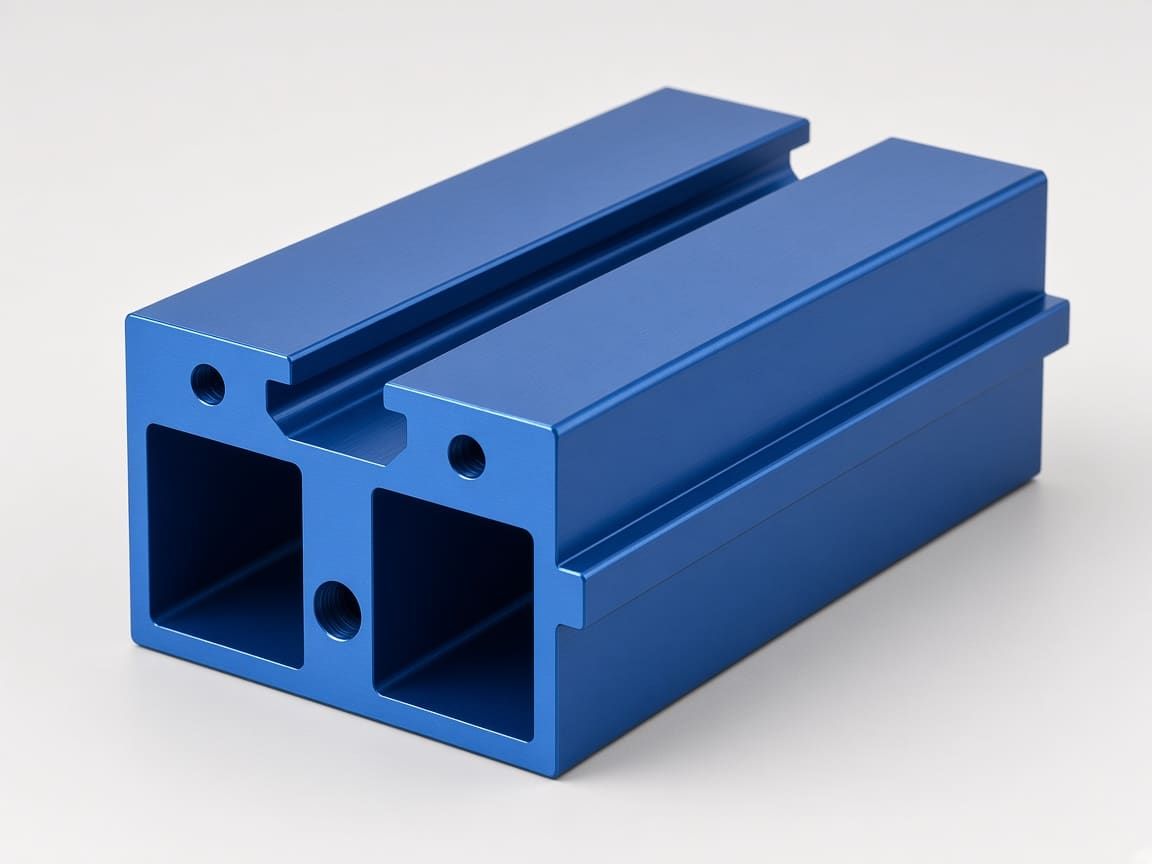
01How anodizing works
Pretreatment
Degreasing, then etching for a matte finish or chemical brightening for a glossy one.
Anodizing
The profile is the anode in a sulfuric-acid bath; current grows a porous oxide layer.
Coloring
Optional — organic dyes, or electrolytic coloring with metal salts for UV-stable bronzes and blacks.
Sealing
Hydrothermal or cold sealing closes the pores, locking in color and corrosion resistance.
02Thickness classes
| Class | Min. average thickness | Typical use |
|---|---|---|
| 5 | 5 µm | Interior, decorative, low wear |
| 10 | 10 µm | Interior, general purpose |
| 15 | 15 µm | Exterior, moderate environments |
| 20 | 20 µm | Exterior, industrial or coastal |
| 25 | 25 µm | Exterior, severe conditions |
Classes follow EN ISO 7599 practice. North American architectural work references AAMA 611: Class II (10–18 µm) and Class I (18 µm and above).
03Colors
Electrolytic colors — champagne, light to dark bronze, and black — are deposited deep in the pores and are highly UV-stable, so they suit facades. Dyed colors, including blue, red and gold, are vivid but can fade in strong sunlight and are best kept indoors. Clear (silver) anodizing is the most common finish of all.
04Designing for anodizing
- Allow for growth. The layer grows roughly half into and half out of the surface — allow for it on tight fits and threads.
- Choose the right alloy. 6063 and 6060 give the most uniform appearance; 6061 and 6082 look slightly greyer.
- Plan contact points. Parts are held on racks; tell us where small contact marks are acceptable.
- Mask what must conduct. The layer insulates electrically, so grounding points are masked or machined afterwards.
- Hard anodizing produces thicker, very wear-resistant layers for sliding and wear parts; it is darker and less decorative.
05Frequently asked questions
How thick is anodizing on aluminum extrusions?
Typically 5–25 µm, chosen by class: 10 µm for interior use, 15–25 µm for exterior. Hard anodizing is thicker — commonly 25 µm and above.
Does anodizing change part dimensions?
Slightly. About half the layer grows outward, so a 20 µm layer adds roughly 10 µm per surface. Tight fits should allow for it.
Does anodized aluminum fade?
Clear and electrolytic (bronze, black, champagne) anodizing is very UV-stable. Organic dyed colors can fade outdoors over time.
Is anodizing better than powder coating?
Neither is universally better. Anodizing is harder and cannot peel; powder coating offers any color and hides surface marks. See anodizing vs powder coating.
Last updated September 17, 2026 · Reviewed by the CharMax Aluminum engineering team