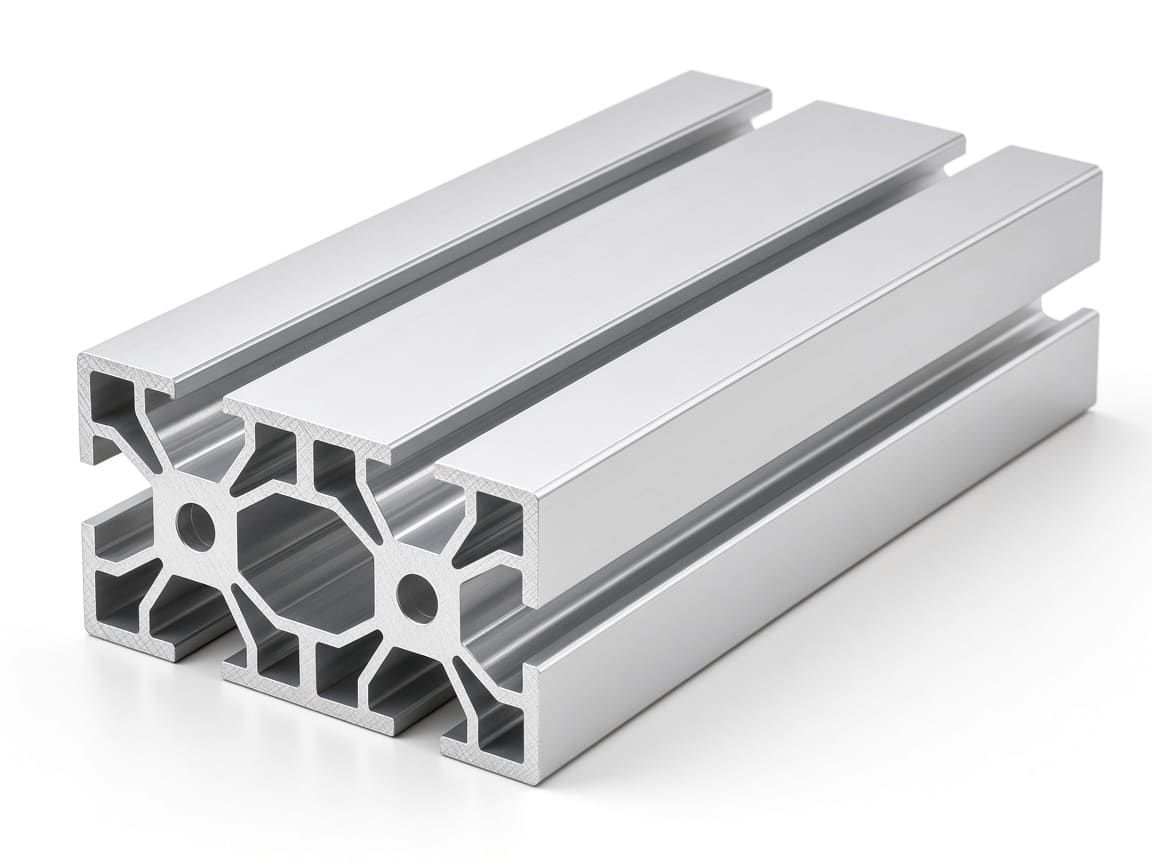
01Chemical composition
| Element | Si | Fe | Cu | Mn | Mg | Cr | Zn | Ti |
|---|---|---|---|---|---|---|---|---|
| Weight % | 0.7–1.3 | ≤ 0.50 | ≤ 0.10 | 0.40–1.0 | 0.6–1.2 | ≤ 0.25 | ≤ 0.20 | ≤ 0.10 |
Registered limits; remainder aluminum.
02Mechanical and physical properties
| Property | 6082-T6 |
|---|---|
| Tensile strength Rm | ≈ 290–340 MPa |
| Yield strength Rp0.2 | ≈ 250–310 MPa |
| Elongation | ≈ 6–10 % |
| Hardness | ≈ 90–95 HB |
| Thermal conductivity | ≈ 170–180 W/m·K |
| Elastic modulus | ≈ 70 GPa |
Indicative ranges spanning typical EN 755-2 minimums and published typical values. Guaranteed minimums depend on temper, wall thickness and profile type — the mill certificate for each lot is the controlling document.
03Trade-offs to know
- Stiffer to extrude — thicker walls and simpler sections than 6063
- Excellent machinability with short chips
- Anodizes for protection; decorative finishes can show streaking
- Welds well, with the usual heat-affected-zone softening
04Typical applications
- Highly stressed structural frames
- Cranes, trusses and bridges
- Transport and trailer structures
- Machined high-strength parts
- Scaffolding and access equipment
05Frequently asked questions
Is 6082 stronger than 6061?
Typically slightly, yes. 6082-T6 has marginally higher minimum strengths in European standards, and the two are often treated as alternatives, with 6082 favoured in Europe and 6061 in North America.
Can 6082 be anodized?
Yes, for protective and technical finishes. For uniform decorative anodizing, 6063 or 6060 give better results.
Last updated September 17, 2026 · Reviewed by the CharMax Aluminum engineering team