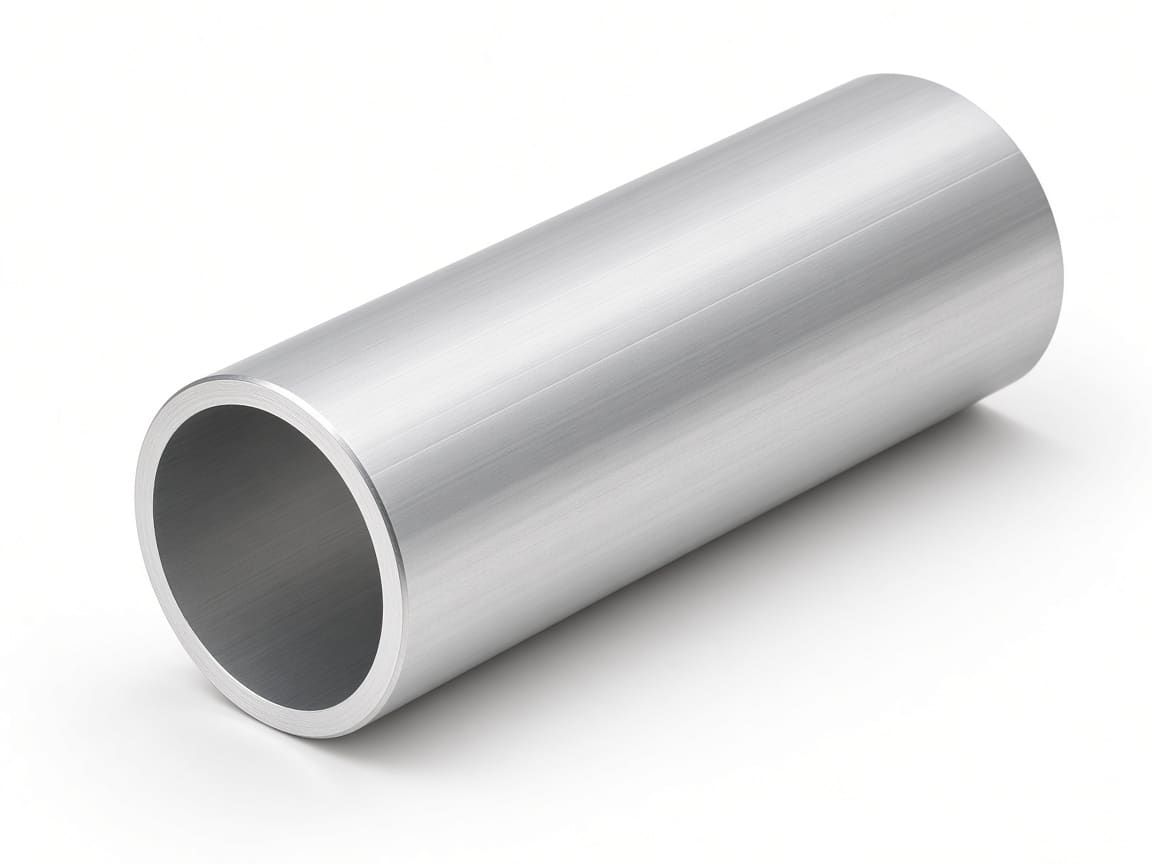
01Chemical composition
| Element | Si | Fe | Cu | Mn | Mg | Cr | Zn | Ti |
|---|---|---|---|---|---|---|---|---|
| Weight % | 0.40–0.8 | ≤ 0.7 | 0.15–0.40 | ≤ 0.15 | 0.8–1.2 | 0.04–0.35 | ≤ 0.25 | ≤ 0.15 |
Registered limits; remainder aluminum.
02Mechanical and physical properties
| Property | 6061-T6 |
|---|---|
| Tensile strength Rm | ≈ 260–310 MPa |
| Yield strength Rp0.2 | ≈ 240–276 MPa |
| Elongation | ≈ 8–12 % |
| Hardness | ≈ 95 HB |
| Thermal conductivity | ≈ 167 W/m·K |
| Elastic modulus | ≈ 69 GPa |
Indicative ranges spanning typical EN 755-2 minimums and published typical values. Guaranteed minimums depend on temper, wall thickness and profile type — the mill certificate for each lot is the controlling document.
03Trade-offs to know
- Harder to extrude than 6063. Slower press speeds and thicker minimum walls raise cost for complex sections.
- Anodizes well, but less brightly. Finishes can look slightly greyer than 6063; fine for technical parts.
- Machines cleanly. Chips break better than 6063, making it popular for CNC-heavy parts.
- Weld softening. Like all 6xxx alloys, strength drops in the heat-affected zone unless re-heat-treated.
04Typical applications
- Structural frames and brackets
- E-bike and bicycle frame tubes
- Machined components and fixtures
- Marine fittings and trailers
- Automation parts under load
- Aerospace ground equipment
05Frequently asked questions
Is 6061 stronger than 6063?
Yes. In T6 temper, 6061 has roughly 30% higher tensile and yield strength than 6063-T6, and more than 50% higher than 6063-T5.
Is 6061 good for anodizing?
It anodizes well for protection and technical finishes, though the appearance is slightly less bright and uniform than 6063. For decorative architectural finishes, 6063 is preferred.
What does 6061-T6 mean?
6061 is the alloy; T6 means it was solution heat treated and then artificially aged to peak strength.
Last updated September 17, 2026 · Reviewed by the CharMax Aluminum engineering team