01Chemical composition
| Element | Si | Fe | Cu | Mn | Mg | Cr | Zn | Ti |
|---|---|---|---|---|---|---|---|---|
| Weight % | ≤ 0.25 | ≤ 0.35 | ≤ 0.05 | ≤ 0.03 | ≤ 0.03 | — | ≤ 0.05 | ≤ 0.03 |
Registered limits; V ≤ 0.05 %; aluminum ≥ 99.60 %.
02Properties
| Property | 1060-O | 1060-H14 | 1060-H18 |
|---|---|---|---|
| Tensile strength Rm | ≈ 70 MPa | ≈ 100 MPa | ≈ 130 MPa |
| Yield strength Rp0.2 | ≈ 28 MPa | ≈ 90 MPa | ≈ 125 MPa |
| Electrical conductivity | ≈ 62 % IACS | ≈ 61 % IACS | ≈ 61 % IACS |
| Thermal conductivity | ≈ 230 W/m·K | ≈ 230 W/m·K | ≈ 230 W/m·K |
Indicative values from published typical and minimum data; properties depend on temper, product form and thickness. The mill certificate for each lot is the controlling document.
03Typical applications
- Electrical busbars and conductors
- Heat-exchanger fins and tubes
- Reflectors and lighting parts
- Chemical and food-processing equipment
- Nameplates, signage and deep-drawn parts
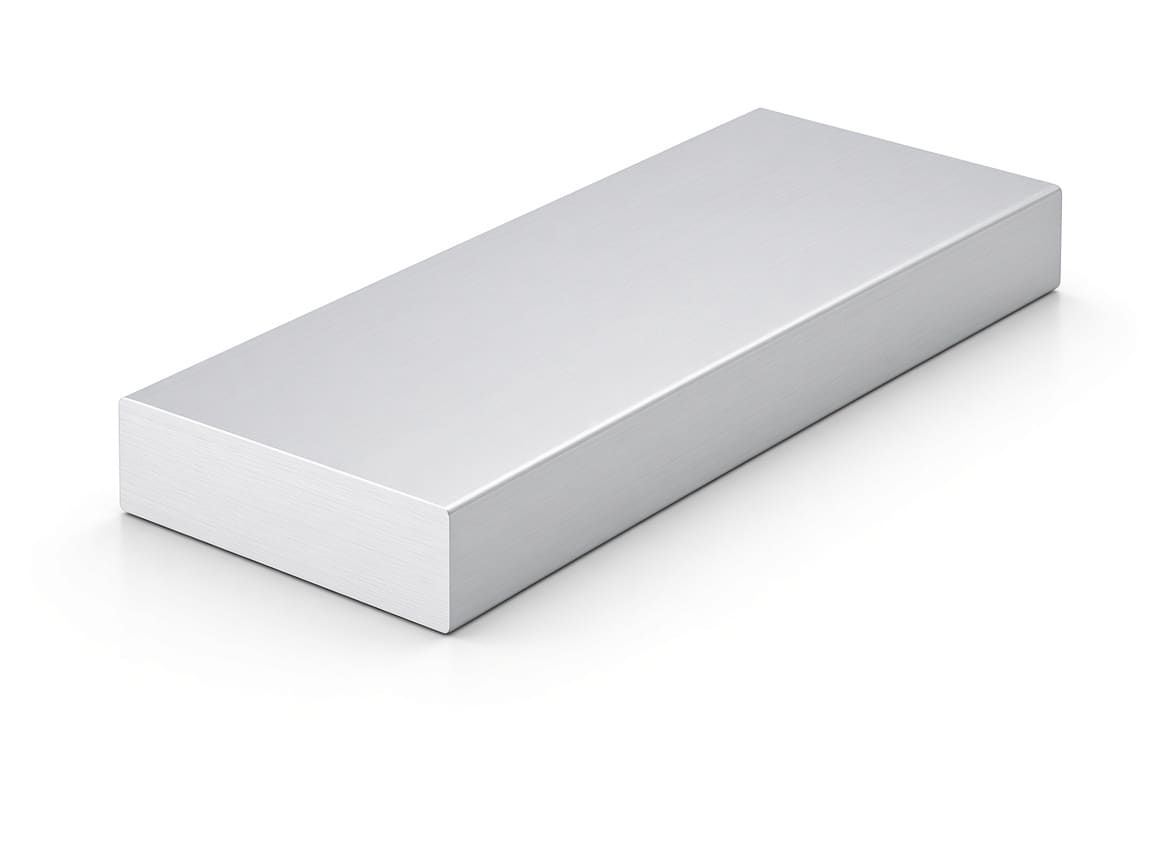
Supplied as bars and flat bars and plate and sheet.
04Frequently asked questions
Is 1060 aluminum strong?
No — it is one of the softest grades. It is chosen for conductivity, formability and corrosion resistance, not strength. For strength, choose 3003, 5052 or a 6000-series alloy.
Can 1060 be heat treated?
No. 1060 is non-heat-treatable; it is strengthened by cold work (H tempers) and softened by annealing (O temper).
Last updated September 17, 2026 · Reviewed by the CharMax Aluminum engineering team